Casa Batlló vs La Pedrera — Which Gaudí House Should You Visit?
Head-to-head Gaudí-house comparison: facade aesthetic, interior tour content, rooftop experience, ticket cost, queue intensity and photography. Plus when to do both.
Casa Batlló and Casa Milà (better known as La Pedrera) sit ≈ 500 metres apart on Passeig de Gràcia — about a 5–7 minute walk — and they are the two best-known Gaudí houses in Barcelona. They are also the two visits most often pitted against each other when visitors only have time for one. This guide settles that head-to-head: how the two facades differ, what each interior visit actually covers, which rooftop experience is stronger, the real ticket costs, the queue dynamics, and when it makes sense to do both anyway.
For a Casa Milà-specific deep-dive — the famous Star Wars chimneys, the Espai Gaudí attic museum, the Mallorca stone formation that inspired the facade, and Josep Maria Jujol’s wrought-iron sculptural balconies — see our sister site at lapedreracasamila.com. This article handles the comparison itself; the sister site handles La Pedrera as a stand-alone monument.
The headline numbers
| Casa Batlló | La Pedrera (Casa Milà) | |
|---|---|---|
| Address | Passeig de Gràcia 43 | Passeig de Gràcia 92 |
| Built | 1904–1906 | 1906–1912 |
| Style | Bone-house facade, dragon-back roof, trencadís-tile | Stone-wave facade, wrought-iron balconies, chimney-army rooftop |
| Patron | Josep Batlló (textile industrialist) | Pere Milà and Roser Segimon (wealthy Eixample family) |
| GYG starting price | $34 / person (Self-Audioguide) | $29 / person (Audio Guide Option) |
| GYG rating | 4.67 / 5 (28,562 reviews) | (newer to GYG; 18,386 reviews) |
| Official venue fee (€, online) | Blue €35 / Silver €40 / Gold €45 / Platinum €53 | Essential €25 / Premium €31 / Night Experience €39.50 |
| Time on site | ≈ 1.5–2 hours self-paced indoors | ≈ 1–1.5 hours self-paced indoors |
| Visit format | 10D AR tablet with animated reconstructions | Audio guide, period apartment + Espai Gaudí attic + rooftop |
| UNESCO status | ✓ (full property) | ✓ (full property) |
| Metro stop | Passeig de Gràcia (L2 / L3 / L4) | Diagonal (L3 / L5) |
The first thing to notice is that La Pedrera is the cheaper interior visit and Casa Batlló is the longer one. La Pedrera’s Essential €25 ticket is the entry point most visitors take and works perfectly well; Casa Batlló’s tiered pricing (Blue / Silver / Gold / Platinum) is more aggressive and the cheapest tier is still €35 online (€39 walk-up with the €4 box-office surcharge). The GYG prices in US dollars run lower than the box-office equivalent because they reflect the audio-guide tier with the GYG affiliate margin baked in. If you are price-sensitive, La Pedrera is the value pick.
The facade — which one is more photogenic from the street
This is where the two diverge most visibly.
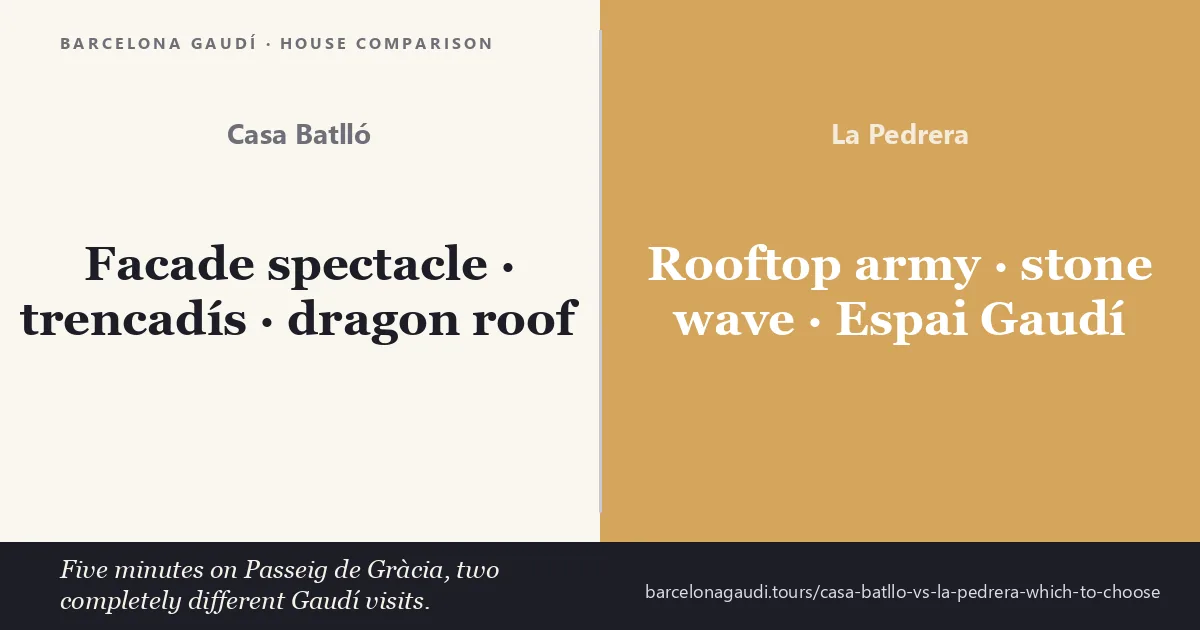
Casa Batlló has the more spectacular facade — the polychrome trencadís-tile front in blues, greens and lilacs, the bone-shaped balcony skeletons (the building is locally nicknamed “Casa dels Ossos,” the house of bones), and the cracked-tile dragon-back roof above. Photographs of Casa Batlló from across Passeig de Gràcia are immediately Gaudí-coded — no one mistakes them for anything else. The facade is also smaller and more contained, which makes it easier to frame in a single shot.
La Pedrera has the more substantial facade — a long, undulating limestone wave with no straight lines, fronted by Josep Maria Jujol’s twisting wrought-iron balcony work in seaweed-like forms. It is bigger, more austere, more architectural. La Pedrera does not photograph as instantly as Casa Batlló (the limestone is a flat warm grey rather than a colour explosion), but it photographs better in oblique morning light and from across the Diagonal intersection where you can see the full corner.
If you only have time to photograph one exterior: Casa Batlló. If you want to photograph one as a Gaudí building rather than a postcard: La Pedrera.
The interior — what each visit actually covers
This is where the two diverge most surprisingly.
Casa Batlló is a fully restored period interior, designed as a theatrical visit. The current ticket includes a 10D augmented-reality tablet (launched in 2021) that overlays animated reconstructions of how the rooms might have looked when the Batlló family lived there in 1906. The route takes you through the noble floor (the main residential floor with the famous sky-blue ceramic stairwell), up through the building’s central light well — the chimney of blue tile that famously graduates from pale to deep — to the attic and out onto the dragon-back roof terrace. The whole visit is curated, lit, and paced.
La Pedrera is a more honest visit. The audio-guide route takes you through one period apartment on the fourth floor (furnished as it would have been in the 1900s with original early-modernist furniture), up to the Espai Gaudí attic exhibition (174 catenary arches that prefigured Sagrada Família’s structural logic), and out onto the famous rooftop — the chimney army of 30+ surreal stone forms, some of which George Lucas reportedly cited as inspiration for the Star Wars stormtrooper helmet design. The visit is less theatrical and more architectural.
If you came for experience design: Casa Batlló. If you came to actually understand how Gaudí thought: La Pedrera.
The rooftop — the real comparison point
Both monuments are famous for their rooftops, and this is where many visitors decide which one they liked more.
Casa Batlló’s roof terrace is small, intimate, and dragon-themed — the cracked-tile spine of the dragon’s back is its signature feature, with views across Passeig de Gràcia toward Tibidabo. The space is tight and feels like a stage set. Good for close-up photos of trencadís detail; less good for crowds (peak hours, the terrace is genuinely packed).
La Pedrera’s roof terrace is enormous, multi-level, and populated by the surreal chimney sculptures. You can walk a circuit around the entire roof, with panoramic Barcelona views in every direction (Sagrada Família clearly visible to the east), and the chimneys give you dozens of photo angles to work with. It is also far less crowded than Casa Batlló’s tighter space.
If rooftop time is the priority: La Pedrera, clearly. This is the single biggest argument for choosing La Pedrera over Casa Batlló when forced to pick one.
Queue intensity and timing
Both monuments use timed-entry tickets, so the “queue” problem is really a crowd-inside problem.
| Monument | Peak crowd hours | Calm hours |
|---|---|---|
| Casa Batlló | 11:00 AM – 3:00 PM | 9:00 AM (opening) or after 5:00 PM |
| La Pedrera | 11:30 AM – 2:30 PM | 9:00 AM or for the Night Experience (€39.50) |
Casa Batlló has the bigger crowding problem because the interior route is narrower and the rooms are smaller — at peak hours you queue inside the building for some of the highlight rooms. La Pedrera’s interior and rooftop are large enough to absorb crowds without forming bottlenecks. The implication: book Casa Batlló for first slot of the morning, or push La Pedrera to a Night Experience evening.
The early-morning access angle is particularly strong for Casa Batlló’s “Be the First” tier (€45 online, €49 box office, opens 08:30 AM — before regular admission) and for La Pedrera’s Premium “Open Date” tier (€31 online — lets you skip the timed-entry constraint and choose your moment).
The nighttime products — 2026
Both monuments run evening experiences that are completely different from the daytime visit, and both are strong reasons to stay an extra night in Barcelona.
Casa Batlló “Magic Nights” is a rooftop-concert series running from April 25 through November 13, 2026. The format is consistent: an 8:00 PM visit through the illuminated house followed by a 9:00 PM live concert on the dragon-back roof terrace, with a welcome drink included. Tickets start at €59 online and run across Blue, Silver and Gold tiers depending on date and seating. It is the most theatrical Gaudí evening in Barcelona — the trencadís roof under stage lighting is a different building from the daytime version.
La Pedrera Night Experience — “The Origins” is more architecturally serious. The €39.50 adult ticket (online) includes a guided tour of the Flower and Butterfly Courtyards and the Whale Attic — the Espai Gaudí space with the 174 catenary arches — followed by the main event: a video-mapping projection on the warrior-chimney rooftop, sequenced to a soundtrack about the building’s origins. The evening closes with a glass of Cava and sweets in the courtyard. It is the only way to see La Pedrera’s rooftop fully lit and free of daytime crowds.
If you can only do one nighttime visit: La Pedrera’s “Origins” rewards visitors who came for architecture; Casa Batlló’s “Magic Nights” rewards visitors who came for atmosphere and live music. Both close out a Day 2 spent on Passeig de Gràcia in a way the daytime visit alone cannot.
Which to choose if you can only do one
Choose Casa Batlló if: you want the more spectacular visit, you respond to colour and theatre over structure, you have less than 90 minutes, photographing the facade matters, you want the most-shot building exterior in Barcelona.
Choose La Pedrera if: you want the more substantial visit, you respond to structure and architecture over theatre, rooftop time matters most, you want better value for money, you want fewer crowds inside, the chimney-army roof and the Espai Gaudí attic exhibition draw you in.
For the architectural-context decision-maker, La Pedrera wins on three out of four axes (value, rooftop, crowds, architecture); Casa Batlló wins on facade spectacle alone. For the photogenic-decision-maker, Casa Batlló wins on facade and stairwell; La Pedrera wins on rooftop. There is no wrong answer — both are UNESCO World Heritage and both deliver an unambiguous Gaudí experience.
When to do both anyway
You should do both if any of these apply:
- You have a full Day 2 free in Barcelona (see our Gaudí multi-day Barcelona itinerary for the standard Casa Batlló AM + La Pedrera midday sequencing — they are 5–7 minutes’ walk apart and the back-to-back contrast is more informative than either visit alone).
- You are an architecture student or enthusiast — seeing the two buildings consecutively shows Gaudí’s evolution from the colour-led 1904 Casa Batlló to the structure-led 1906–1912 La Pedrera in a way no separate visit can.
- You have the budget — combined GYG ticket cost is ≈ $63 ($34 + $29), and the two visits take ≈ 3 hours total including the walk between them.
For first-time Barcelona visitors who only have time for one Gaudí house, our broader which Gaudí monument to visit first guide makes the case for skipping the houses on Day 1 entirely and anchoring around Sagrada Família — the houses become Day 2 territory once you have the Gaudí Rosetta stone in your head.
The Catalan Modernisme context
Both Casa Batlló and La Pedrera belong to Catalan Modernisme (1888–1911), the Catalan Art Nouveau movement that produced three principal architects working in conversation with each other: Antoni Gaudí (1852–1926, born Reus), Lluís Domènech i Montaner (1850–1923, whose Palau de la Música Catalana and Hospital de Sant Pau are UNESCO World Heritage in their own right) and Josep Puig i Cadafalch (1867–1956, whose Casa Amatller, Casa de les Punxes and the Casaramona factory — now the CaixaForum arts venue — anchor the non-Gaudí Modernisme circuit). Modernisme is distinct from French Art Nouveau and Vienna Secession — it carries a specifically Catalan cultural-political weight tied to Catalan identity. Gaudí himself was a devout Catholic Catalanist who died in Barcelona on June 10, 1926 (struck by a tram on Gran Via).
A useful corrective: Casa Batlló’s neighbours on its own block of Passeig de Gràcia are by other Modernisme architects, not Gaudí. The “Illa de la Discòrdia” (Manzana de la Discordia in Spanish) is the block between Carrer del Consell de Cent and Carrer d’Aragó, numbers 35 to 43, with five buildings by four different architects: Casa Lleó-Morera (No. 35, Domènech i Montaner, 1902–1906), Casa Mulleras (No. 37, Enric Sagnier, 1906–1911), Casa Bonet (No. 39, Marcel·lí Coquillat, facade 1915), Casa Amatller (No. 41, Puig i Cadafalch, 1898–1900) and Casa Batlló itself (No. 43, Gaudí, 1904–1906). If you have an extra hour after Casa Batlló, walking the same block to see Casa Amatller (Puig i Cadafalch’s Catalan-Gothic-meets-Flemish-gable facade) and Casa Lleó-Morera (Domènech i Montaner’s floral-tile lobby) is the simplest way to see what non-Gaudí Modernisme looks like in direct comparison. La Pedrera (Passeig de Gràcia 92) is three blocks further north, so it is not part of the Discord conversation — it is Gaudí’s later, more austere reply to the Discord-block argument.
2026 marks the centenary of Gaudí’s death. The Sagrada Família’s Tower of Jesus Christ reached its full 172.5-metre height on February 20, 2026 specifically to mark the centenary — Sagrada is now the tallest church in the world — and the basilica hosts a Solemn Centenary Mass on June 10 itself, with a companion exhibition running April through July. Both Casa Batlló and La Pedrera will be quieter than Sagrada this year for that reason — the centenary attention concentrates on the basilica.
Ready to Book?
The Sagrada Familia Guided Tour with Skip-the-Line Entry — rated 4.87/5 by 238 guests — is the strongest first-day Gaudí anchor, after which Casa Batlló and La Pedrera become natural Day-2 territory. A Catalan local guide, priority entry past the queue, 1.5 hours decoding the basilica’s symbolism and stained glass. From $80 per person, free cancellation up to 24 hours.
Decode Gaudí's Sagrada Família — Catalan-Led, Skip-the-Line
Join 238+ guests who rated this Sagrada Família tour 4.87/5. A 1.5-hour Catalan-guided tour of light, symbolism and stained glass — priority entry included. Free cancellation.
Check Availability & Book